
How the Proximity Algorithm Decides Which DC Ward You Actually Rank In
Imagine your boutique fitness studio is thriving in the heart of Dupont Circle. You’ve invested heavily in google business profile seo, your reviews are glowing, and your local community loves you. Yet, when a potential client just a few blocks away in Logan Circle or Shaw searches for “fitness studio near me,” your business is nowhere to be found in the local map pack. This isn’t a glitch; it is the “Proximity Filter” at work. In the dense, high-stakes landscape of Washington D.C., the distance between a searcher and your front door is often the single most significant factor determining whether you exist in the digital eyes of the District.
The Trinity of Local Search: Relevance, Distance, and Prominence
To understand why your ranking fluctuates as you cross from Ward 2 into Ward 6, we must look at the three pillars of Google’s local search algorithm: Relevance, Distance (Proximity), and Prominence. While Google is famously tight-lipped about the exact weightings of these factors, industry research and local data analysis suggest that Relevance accounts for roughly 25% of the signal, while Distance sits at approximately 15%. However, in a hyper-dense urban environment like Washington D.C., these numbers are deceptive. Proximity often acts as the primary “gatekeeper.”
Relevance is how well your google business profile seo matches what someone is searching for. Prominence is how well-known your business is (based on links, articles, and reviews). But Distance – the proximity algorithm – is the physical reality of the searcher’s latitude and longitude. In the District, where neighborhoods are packed tightly together, the “radius of influence” for a local business can be incredibly small. If you aren’t optimized specifically for the nuances of D.C. geography, you might find Why Your DC Shop is Missing from Nearby Search Results Even with a Verified Profile to be a sobering but necessary read.
In 2026, the google maps algorithm has become even more sensitive to user movement. As a user walks down 14th Street NW, the map pack can refresh and completely change the top three results within three blocks. This “micro-proximity” means that being “in D.C.” isn’t enough; you have to be relevant to the specific street corner where the search originates.
Why DC is a “Constellation of Micro-Markets”
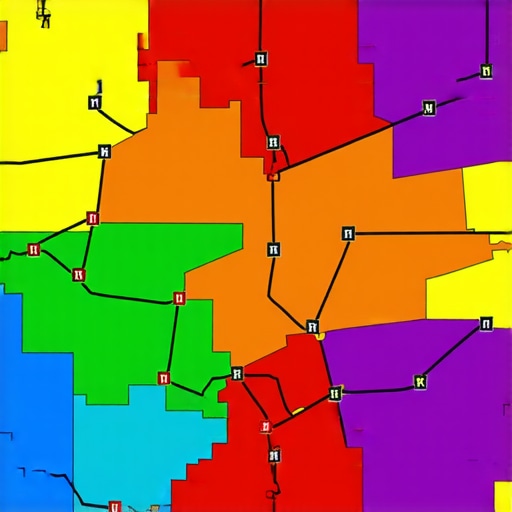
Washington D.C. is unique among American cities. It is not a monolithic urban sprawl; rather, it is a “constellation of micro-markets.” From the corporate corridors of Downtown to the historic cobblestones of Georgetown and the rapid development of the Navy Yard, each area carries its own digital signature. The District is divided into 8 Wards and dozens of Advisory Neighborhood Commissions (ANCs), and these boundaries create artificial but powerful filters in the eyes of the algorithm.
When the DC Council approved the 2022 Ward boundary updates, it didn’t just change who votes where – it shifted the underlying data structures that search engines use to categorize local intent. For a business owner, this means that a google maps ranking service like seovipertools.com is essential for tracking how these shifts affect visibility. Google’s AI looks at these boundaries to understand community clusters. If your business is located in Ward 3 (Upper Northwest), the algorithm assumes your primary relevance is to residents of Cleveland Park or Woodley Park, not someone looking for services in Ward 8 across the Anacostia River.
To effectively rank google business profile listings across the District, you must acknowledge that a “one size fits all” D.C. strategy will fail. You are competing in a series of smaller battles: the battle for Adams Morgan, the battle for Capitol Hill, and the battle for H Street. Recognizing these micro-markets is the first step toward a successful How to Beat the Proximity Filter and Rank Across Every Ward in the District strategy.
The “Hard Filter” Problem: Why You Vanish Across Ward Lines
The “Hard Filter” is a technical reality of local maps ranking seo. Google often applies a “centroid bias,” where it favors businesses located near the geographic center of a search area. If a user searches for “Lawyers in DC,” Google looks toward the downtown “centroid.” If they search for “Plumbers in Ward 5,” the focus shifts to the center of that specific Ward. If your business is located on the edge of a Ward or near a major boundary – like the Anacostia River or Rock Creek Park – you face an uphill battle to rank on the “other side.”
This is particularly frustrating for local seo services providers who see their clients ranking #1 for a keyword in their immediate 500-meter radius, only to drop to #20 once they cross a major thoroughfare like Florida Avenue. This happens because Google’s algorithm treats these boundaries as “contextual breaks.” To overcome this, google business profile optimization via seovipertools.com is required to signal to Google that your service area is broader than your physical footprint.
Furthermore, the google maps algorithm heavily weighs “local map pack seo” signals that confirm your presence in adjacent areas. If all your reviews come from residents in Georgetown, Google has no reason to believe you are the best choice for a customer in Benning Ridge. The algorithm is designed to minimize friction for the user; if it thinks a river or a 20-minute traffic jam on I-395 stands between the user and your business, it will simply show them a closer, albeit perhaps lower-rated, competitor.
2026 Tactics to Expand Your DC Ranking Radius
As we move through 2026, simply having a verified profile is the bare minimum. To increase google business profile visibility across the District, you need to employ hyperlocal tactics that “stretch” your proximity influence. Here are three expert-level strategies:
1. Hyperlocal Content and “Geo-Pages”
Don’t just have a “Services” page. Create “Geo-Pages” dedicated to specific Wards or ANCs. For example, a roofing company based in Ward 4 should have a page titled “Roofing Services in Ward 6 / Navy Yard.” This page should mention local landmarks, specific neighborhood challenges (like historic district regulations in Capitol Hill), and include testimonials from clients in that specific Ward. This builds “Relevance” that can sometimes override the “Distance” penalty. You can find more on this in our guide: 3 New Maps Ranking Signals DC Businesses Need in 2026 [Tested].
2. Neighborhood-Specific Backlinks
In the world of google maps seo, a link from the PoPville blog or a neighborhood ANC website is worth ten links from national directories. These signals tell Google that you are an authority within the D.C. ecosystem. When local blogs mention your business in the context of a specific neighborhood, it reinforces your “Prominence” in that area. Utilizing local seo tools from seovipertools.com can help you identify where your competitors are getting these hyperlocal mentions.
3. Geo-Tagged Media and Real-Time Signals
Google’s ability to read metadata in photos is more advanced than ever. When you complete a job in Ward 7, take a photo and upload it to your Google Business Profile. The EXIF data (latitude and longitude) embedded in that photo acts as a “proof of service” signal to the algorithm. This is why DC Maps Ranking: Why Geo-Tagged Photos Still Matter in 2026 remains a cornerstone of District SEO strategy. It tells the algorithm, “Yes, I am located in Ward 2, but I am actively providing value in Ward 7.”
The Role of “Prominence” in Overcoming Proximity
While the proximity algorithm is powerful, it is not invincible. “Prominence” is the lever you pull to break the proximity barrier. If your brand is strong enough – meaning you have a high volume of high-quality reviews, significant local press, and a high click-through rate – Google will “stretch” your radius. This is why a world-famous restaurant in the Wharf can still rank higher on google maps for a user searching in Tenleytown, while a mediocre cafe next door to that user might not even show up.
To improve google maps rankings through prominence, you need a consistent strategy for review acquisition and local brand mentions. Using seovipertools.com to monitor your brand’s “share of voice” across different D.C. neighborhoods will show you where your prominence is failing to overcome the distance gap. Remember, the algorithm wants to provide the best result, not just the closest one. If you can prove you are significantly better than the closer options, Google will reward you with a larger “radius of influence.”
Conclusion: Auditing Your Ward-Specific Visibility
The proximity algorithm is a reality of doing business in Washington D.C., but it shouldn’t be a death sentence for your growth. By understanding that the District is a “constellation of micro-markets” and using 2026-ready local seo strategy tactics, you can expand your reach far beyond your physical Ward. Don’t let a national agency tell you that you’re “ranking in DC” when you’re actually invisible in the Wards that matter most to your bottom line. It’s time to perform a deep dive into your local presence and address the 7 Performance Gaps to Check in Your 2026 DC SEO Agency Audit.
As Kevin Pauls – Local SEO Consultant, I have seen firsthand how a neighborhood-centric approach can transform a struggling profile into a District-wide powerhouse. The algorithm is changing, but the geography of D.C. remains constant. Master the map, and you master the market.